Saturday, April 26, 2014

Plein Air Painting The Indian River Lakes, Northern NY

I was asked to write an article on plein air painting the Indian River Lakes  by the Indian River Lakes Conservancy (IRLC) for their next newsletter. The text and pics submitted are below. By way of background,  there are  eighteen naturally formed lakes by glacial erosion and melting. They all feed into the Indian River which in turn feeds into the St Lawrence River, 1000 Islands region. Two are private and the rest  have access provided by a Town or NY State Department of Conservation (DEC).  The lakes are great for fishing and DEC has classified  them in three groups, shallow productive, deeper and clearer and deep cold water. The lakes stretch out for forty miles in a NE direction , in parallel  direction to the St Lawrence River. Here is the article and pics:

Plein Air Painters Thousand Islands region (PAPTIR) was founded in 2009 to foster painting outdoors in the region, a practice that was spreading rapidly across the U.S. In July 2010, the Thousand Islands Land Trust (TILT) sponsored a canoe/kayak trip on Grass Lake. Some of us PAPTIR painters participated in the event which started the love affair with the Indian River Lakes (IRL) and the Indian River as great painting sites. However, there are three P's required for a painting site: Point of View, Parking, and Potty. The third P is hard to find on the the IRLs.  At many of our other painting sites the nearest gas station or restaurant meets the third P requirement. In July 2011 TILT and IRLC jointly sponsored a canoe/kayak trip on Millsite Lake. Some of us arrived early and painted from the DEC launch site (it has the third P). My painting of Millsite from the launch area is below.
Millsite  Lake 9 x 12 oil
In 2012 and 2013 Cindy and Phil Gentile hosted us at Grass Lake. Generally participants arrive at 9:00 to 9:30 a.m. with a packed lunch, assemble at 1:00 p.m.to eat and socialize and then return to painting and depart on their own schedule. However, Phil  likes to cook and entertain and they showed us a great time. Most times when we are hosted , PAPTIR participants bring a dish and beverage to share and the hosts party with us. Below are paintings by Lori McCall  and Jan Byington done in 2013 from the Gentile's dock. Lori's "Across The Lake" zooms in while Jan's "Grass Lake Shoreline" is a broader view, illustrating  two different artistic interpretations  of the same scene. Also pictured are Lori and Linda Palmer painting and Jan (left to right) setting up her easel
on Gentile's dock.
Across The Lake By Lori McCall
Grass Lake Shoreline  BY Jan Byington


Lori, Linda Palmer, and Jan
When at a lake site it is nice to have a kayak as it offers the opportunity to seek more " Points Of View" or get around to take photo references for studio paintings. Below is a pic of Jan's two person kayak which I often coax her into bringing.

Of the 60 artists on the PAPTIR email distribution list about 20 have painted at one time or another. Others tell me that some day they will make a paint out or don't reply to be removed from the distribution list. Typically a paint out is attended by five to 7 artists. Black Lake (the largest) is another Indian River Lake we have painted at while participating in the Morristown Public Library Plein Air Fest in 2013. We have also painted twice each at the Indian river at Theresa and Philadelphia N.Y.
We are looking forward to the development of Boyd Pond (and planned portable restroom) as it might also offer some painting views of Lake of the Woods. In doing some research for this article I reviewed a wire bound booklet "Exploring the Redwood Lakes", that I have had for some time. I found some enticing photos of Butterfield Lake, Crystal Lake (Campground) and Sixberry Lake with notations that the all important restroom is available at them, but not at the other five Indian River Lakes included in the booklet. I still have to drive there and check out the Point of View so that my participating artists don't get disappointed.


Sunday, April 13, 2014

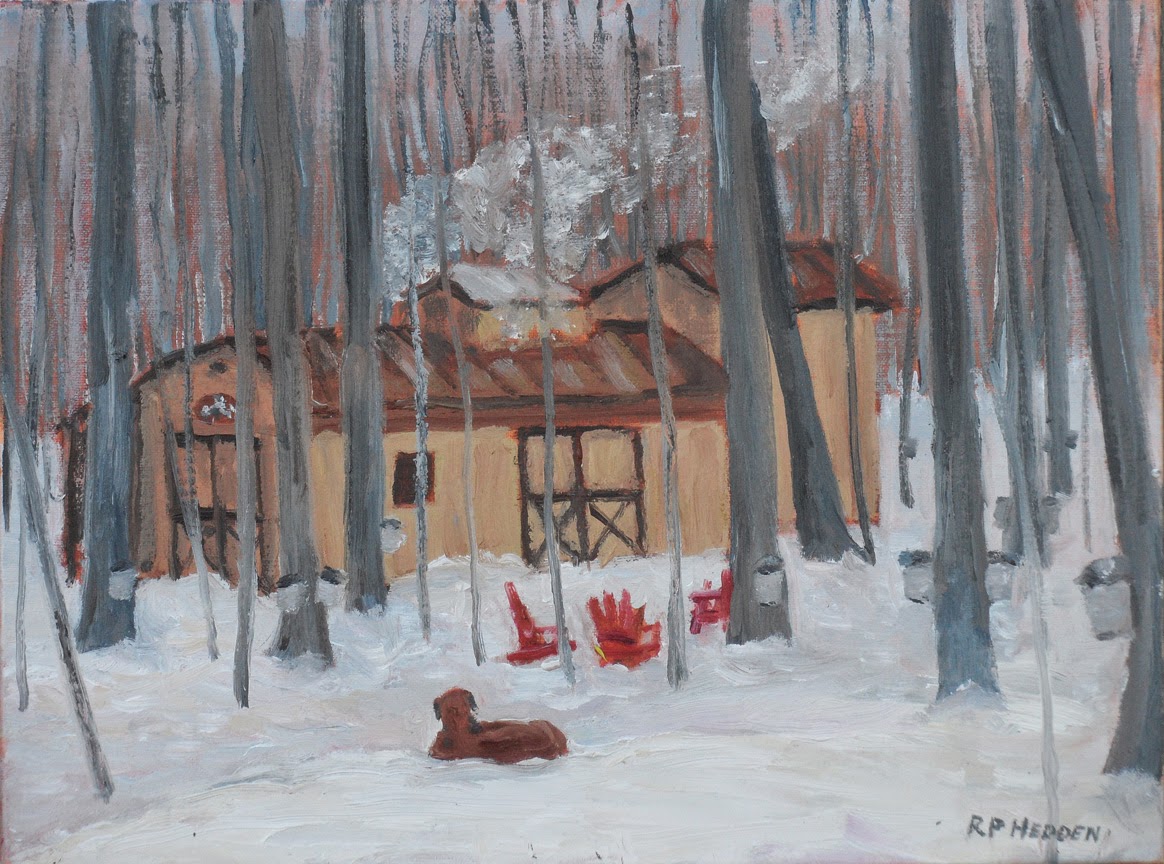
En Plein Air at the Tapped Oak Sugar Shack, Northern NY

My 9 x 12  plein air of the Sugar Shack

Jerry Merrill and Jan Byington
 It is April 13 as I write this and a hard to believe 75 degrees F. We painted on  Saturday March 30 on a cloudy 40 degree day and the next day another 9 inches of snow blanketed the area. This was  our first plein air outing since last November so it was like a spring training camp getting back in the grove.
 The Sugar Bush got it's name as the beginner owner tapped an oak tree. Just today the Sunday paper had an extensive front page article about making syrup from walnut tress as well as  birch trees and detailed much information on the advanced technology currently used to produce maple syrup.
Jerry's painting in the photo is completed as he started early, living just a few miles from the the site. Jan's is in progress. To see closeups of Jan's finished painting as well as Jerry's here is the link to Tapped Oak Sugar Shack Facebook page:

www.facebook.com/tappedoak

When we entered the shack  to get a mid morning warm up we were greeted with pancakes, syrup, ans sausage patties and an assortment  of beverages on tap. By the time we finished the paintings and went back to the shack there was  more food selections and quite a party in progress with the neighbors.  As the web site says: "Produced by Scott, Joe and Jay, 10 kids and 3 dogs."  The sounds of kids playing rang out in the woods all morning. The reddish brown Labrador in my painting is quite up in age and kept me company yet had his eyes on the activity in the shed. He later followed me, hobbled into the shed and gracefully deposited himself on the floor near the still  and in the middle of the party. If you check out the Facebook page you'll see why we hope this will be an annual outing for us. Sorry for  all our snowbirds who paint with us and are still in warmer climates.
Sign and Logo

Tuesday, March 18, 2014

Typha, cattail, catninetail, punks, corn dog grass, bulrush, reedmace, get your veggies free!

Spring Cattails II


 These are companion paintings to my last post on  the "First Light Edge Lit Cattails" painting. That was  an oil on 18 x 24 inch (30cm x 61cm). These are  11 x 15 inches (28 cm x 38 cm) oil on gessoed panel for  Cattails II and 12 x 9 inches (30.5 cm x 23 cm) oil on linen covered panel for Cattails II.

 
Spring Cattails I
Now, for everything you ever wanted to know about cattails. Typha ('taifa) is a genius of about eleven species in the family of Typhaceae which are largely a Northern Hemisphere distribution.       The many common names in American English are cattail,      catninetail, punks, or corn dog grass.  In British English, bulrush or reedmace. The rhizomes are edible and evidence of preserved starch grains on grinding stones indicates they were consumed in Europe 30,000 years ago. Before you  rush  to harvest some for your table, plants growing in polluted water can accumulate   lead and pesticide residues in their rhizomes. However,  the rhizomes  have a protein content similar to maize or rice and can be made into flour.  The outer portion of young plants can be peeled and the heart can be eaten raw or boiled like asparagus, In late spring when they are tender the leaf bases can be eaten raw or cooked. In early spring the  sheath from the developing green flower spike  can be boiled and eaten like corn on the cob. Mid-summer pollen from the male flower can be used as a flower supplement or thickener.

Other uses are chair seating with the dried rushes,  feeding the seeds to cattle and chickens, thatching roofs, construct rafts and other boats. The down (seen in the above paintings) was used by the  US Navy as a substitute  for kapok in life vests, The down can be used as insulation in buildings, stems and leaves can make paper (hand made-decorative), Fiber from the stems can be used to make raw textiles and leaf fibers can be used as an alternative to cotton and linen in clothing. They are considered as a source of starch to produce ethanol and are considered to be a bio-energy crop. The seed hairs can be used as tinder to start fires. They are frequently eaten  by wetland mammals such as muskrats and birds used the seed hairs  as nest lining.

Sex and the Cattail.
The plants have uni-sexual flowers (biological term is monoecious) with the male flower forming a narrow spike at the top of the stem which withers once the pollen in shed. The dense, sausage-shaped spike is a large number of female flowers below the  male spike. The minute seeds are attached to fine hairs and when ripe turn into a cottony fluff  eventually dispersed by the wind.

The above is a condensation and paraphrasing of  information found  in Wikipedia, the free encyclopedia if you are interested in more detail.


Tuesday, March 4, 2014

Boldt Canal Wellesley Island NY 1000 Islands Region

Spring Marsh Cattails
 Still confined to the studio for painting by the coldest and snowiest winter  in years I searched  my photo files  for some inspiration In the spring of 2013 I took an early morning walk in the vicinity of Boldt Canal on Wellesley Island, just a few miles west of  our home and took a lot of photos. George Boldt (1851-1916) is known to many for Boldt Castle on Heart Island in the St Lawrence River, Alexandria Bay NY. As the story is told, George  had his beautiful residence on the island demolished to begin construction of a castle. Work was halted upon his wife Louise's death.  The Castle is currently owned by the Thousand Islands Bridge Authority and has been undergoing continuous restoration and completion since the early 1980's. It is a popular tourist site and several boat lines bring visitors to the Island. It is also a popular wedding site. George owned the Waldorf-Astoria  Hotel in New York City and the Bellevue-Stafford in Philadelphia PA. He had a large farm on Wellesley Island that was a vegetable farm and also raised chickens, ducks, turkeys, geese, and an assortment of livestock.

Reflections in the marsh
 George had a canal system built on Wellesley Island to get the produce, eggs, etc,, from the farm to the St Lawrence River and and  then US Mainland where trains where used for shipping to his hotels.. A picture of the  main section of the canal is shown below at the bottom..Bullhead fisher persons can  be found along the bank and in small boats in the April time frame.
My painting is of a marsh section near the canal and is based on the sites and sensations accumulated on the early morning walk. In the 1980's I rode my mountain bike over some back roads in the area and  in the 90's I walked our red Doberman (untrimmed ears as is the practice or law in England).  The painting is a composite inspired by the three photos below the painting, in  particular the one with the early morning  back light causing edge lighting on the cotton like seed balls of the spring cattails.


Edge Lighting  Effect of the sun low in the Sky

Cattails in the Morning Sun

Main Section of Boldt Canal

Wednesday, February 19, 2014

Frederick Church's Olana

View of the Hudson River from Olana
Currently there is a painting series on PBS TV, "Landscapes Through Time with David Dunlap".
More about David and the Series at the link http://www.landscapesthroughtime.com/
Today's show was "Frederic Church's Olana in the Hudson River Valley, NY". In October 2012 I took a plein air workshop  given by one of the signature members of Plein Air Painter of America, It was held near  Olana (Frederic Church's Persian Style home built on a hill overlooking the Hudson River). Frederick Church's  only art education was two years study with Thomas Cole, the founder of the Hudson River School of Art.  Church was  financially successful and great at marketing his paintings. David Dunlap's series is more about the "principles" of art"  rather than "techniques", although the series covers many locations in Europe and the US where famous artists painted and  he provides a historical background, demonstrates and discusses their technique with painting sketches, and then provides some instruction in the principles in his  live painting sketch, and later, by modifying a student's  painting  that is in progress somewhere in the location that he demonstrated from. Quite a lot packed into a half hour.

In today's show, David  Dunlap stood almost where I stood when I painted  the above scene. He faced a little more to the right, leaving out the man made pond to the left that Frederic Church had constructed. His oil painting sketch included the green sloped area and the little path or road that crosses it. He also excluded the little group of trees in front of the tree line that the path goes through (principle of simplification). The group of trees was not visible in the show because of the way his easel and the camera were positioned..He also put in more sky  and took the liberty of inventing his own sky with  the clouds at a diagonal to the left and down, as a counterbalance to the  downward diagonal of the green slope. (principle of motion and  linear perspective).
During his demonstration he mentioned  da Vinci and  used the word "sfumato", which translates as "turned to mist" or "going up in smoke".  Art critics use the term to describe the hazy, mysteriously quality that was one of  da Vinci's most distinctive painting characteristics.  I also thought I heard Mr Dunlap use the "sensazione" , the continual refinement of the senses, especially sight, as the means to enliven experience. For Leonardo  da Vinci  vision was the supreme sense, and painting was therefore the greatest discipline.

In my last blog I mentioned "synchronicity", the occurrence of a series events, things... which cause you (or should cause you) to stop and think and look for some meaning. An example I recall reading once was perhaps meeting a person you had not seen in a long time, you greet and go your respective ways, and low and behold you meet a second and third time in an unplanned coincidence of  going to the same events or places..Well my synchronicity experience in this blog is that a few days ago the book "How to Think like Leonardo da Vinci " by Michael J. Gelb, was staring at me from the book shelf  to the side of the TV. I took it down and  reviewed all my underlined sections, notes in the margins, sheets of paper where I did the suggested exercises, and reread some of my favorite sections, one of which was the seven Da Vincian Principles, two of which are "sensazione" and "sfumato". Also the section in the rear with the exercise  "Explore Your Goals". This caused me to search my stack of brochures  for "The Hudson Rover School Art Trail", which I picked up when I took the above mentioned  plein air workshop. The trail covers the northern section of the Catskill Mountains and takes you to  eight sites. The first two are Thomas Cole National Historic Site and Olana (I saw some additional painting sites in David Dunlap's  show which inspired me), then  Catskill Creek, Kaaterskill Clove, Kaaterskill Falls, North South Lake, Sunset Rock,  and  Catskill Mountain House.. Three sites require hiking on a marked trail the others are easily accessible from parking lots. I just want to pack up my plein air painting gear and  go for a week, and paint the scenes that Charles Herbert Moore, Thomas Cole, Frederick Church, Asher Durand, Sanford Gifford, and Jasper Cropsey  made famous. Too much to do, to little time left. Anyone want to go?

Saturday, February 8, 2014

A Break In The Weather allowed me to Photograph Some Repaints

Crooked Creek-St Lawrence River


On Tuesday Feb 4th the temperature was 25 degrees F and the sun  reflecting off the snow, provided good light in the shade against the barn where I place my paintings to photograph. Little did I know I would be clearing 12 inches of snow on Wednesday-the forecast was for 3 to 5.
Restricted to painting in the studio for months I repainted two watercolors  that I was unhappy with. I recall reading an article by a very accomplished water-colorist who said he discarded 11 of 12 watercolors. He went on to describe how he rescued many by painting acrylic gesso over the parts he did't like  and painting with
watercolor over that and liking the textured surface. My method is to start from scratch. Crooked Creek was painted from a photo taken on a trip sponsored by the Thousand Islands Land Trust (TILT). The creek feeds into the 1000 Islands Region of the St Lawrence River. It is one of TILT's conservation properties to protect wetlands for wildlife as well as maintain the beauty of the region by limiting development. Last summer I had the chance to revisit the creek again on a kayak trip sponsored by TILT.
Brown Bay -US St Lawrence River


Brown Bay on the US portion of the St Lawrence River in the Narrows section is where I live. (There is a Browns Bay 20 miles down river on the Canadian Side). This portion of the bay is 100 yards to the right of our home and I paddle boat or canoe into the area  to observe turtles, fish, ducks, heron, musk rats, and water snakes. This is another repaint using a photo reference. This summer I am going to set up my easel on the section of Peel  Dock Road that I took the photo from and plein air paint the scene. Plein air painting  loosens up my style  and I simplify by eliminating detail.

Below is an oil painting using a photo reference of the trail to Butterfield (Grand) Lake constructed by the Indian River Lakes Conservancy (IRLC). I took a winter hike two January's ago sponsored by IRLC. IRLC was formed in 1998 to conserve critical lands in the Indian River Lakes area of Northern NY. There are 18 lakes which feed the Indian River which flows into the St Lawrence River in the 1000 Islands Region. The reason the painting is part of today's blog is a coincidence (something I would call a synchronicity). Last Night I attended the opening of Thousand Islands Art Center Winter Show. I met one of the Directors of IRLC who said she was interested in purchasing paintings of IRLC lands for the office. I told her about this one and that it was currently hanging in the Minna Anthony Nature Center, Wellesley Island State Park. She lives on and owns an  Organic Farm   on the road into the State Park. Well, the synchronicity part of this tale is that when I signed onto my web site to retrieve the verbiage for the first two paintings in this blog,  the painting was the first in the list of  most recently viewed paintings (someone from Beverly Hills CA).

Butterfield Lake Trail- Indian River Conservancy (Sold)


Saturday, January 18, 2014

Shadowed Hill

Ice Melt Stream
A walk on the trails in Minna Anthony Common Nature Center in Wellesley Island State Park NY provides lots of interesting landscape painting subject matter so I am always equipped with my camera. This is one of my "What is it?" series inspired by  slight depression from the short winter daylight and light deprivation. You walk across the  Gallery to see "what it is"  and then may not know without some help from the painting title. A rule of painting is to not have an even distribution of light and dark areas in a painting, so I decide to break the rule with this almost 50/50 distribution.The scene reminds me of the game "pick up sticks" with all the fallen tress from over the years. I have cabin fever from not being able to paint from life outdoors as the 2013/2014 winter here on the St Lawrence River near the Canadian border has been a hard one so far. Often I am too tired after. cleaning snow to paint in the studio. It's snowing now as I write this. The second painting "Ice Melt Stream",  has a title inspired by the recent ice storm. I did not lose phone or internet connection but both Time Warner Internet line and Verizon Phone line were laying on the ground  as a result of the weight of the ice. Normally they are attached at the top of the second floor of the house. The scene is also inspired by photos from Minna Anthony Nature Center trail walk. Interesting how the stream created only by years of melting snow has eroded the soil  from the tree roots.

I took four watercolor paintings down from the entrance hallway in the house to put in new mats and do some conservation. They are four street vendor scenes inspired and painted in 1987 by a trip that year that included a few days in Athens Greece. The vendors ply their wares in the Plaka (plaza) section of old Athens which is a favorite hangout for  locals and tourists. If interested you can find them on my Facebook Page.